
What Maryland Property Values Mean
A Maryland parcel record can show three related numbers. One is a current market estimate. Another is the tax-facing assessable value. A third is the consideration reported when the parcel last transferred. These figures are related but not interchangeable. Land and improvement lines split the market estimate into parts, while the last sale price describes one deal at one moment, so read each field name and its date before weighing a listing, a nearby sale, or an assessment notice against the record.
| Recorded figure | What it means | Where it appears |
|---|---|---|
| Current / total market value | SDAT’s full-cash estimate as of the latest assessment or finality date | SDAT parcel result |
| Assessed / assessable value | SDAT assessment fields; the assessable amount reflects phase-in, caps, and applicable credits | SDAT parcel result |
| Last sale price / consideration | Price or amount reported for a transfer, with date and sales-analysis details | SDAT sale segment and deed |
| Land / improvement value | Market-value components attributed to land and structures | SDAT parcel result and public-data layout |
"Market value" in the record means the assessor's estimate. That is not a private appraisal. Assessable value sits closer to the base used for tax calculations, yet it still does not reveal the balance on a bill. A recorded sale is historical evidence only. The transaction could be a gift, a family transfer, a foreclosure, a deed correction, or a non-arm's-length deal. Comparing values makes sense only when the dates, the definitions, and the sales context stay visible.
Find a Maryland Property Value
The statewide assessment search is the direct source for official parcel figures. Pick the county or Baltimore City first. Then use an address, street, or account identifier. Owner-name, town, subdivision, and ZIP searches are not offered. If an address fails, the full parcel account or map reference often gives a cleaner match, so start at the Maryland real property data search.
- Select the correct Maryland county or Baltimore City and search the address or PAN.
- Record current market value, land value, improvement value, assessable value, and the assessment or finality date.
- Open the sale segment for seller, transfer date, consideration, sales-analysis code, and deed reference.
- Compare the figures only after noting their dates and whether the sale was a typical market transaction.
- Assessed value
- The value carried on the assessment record; in Maryland, read the specific market and assessable fields.
- Market value
- The assessor’s full-cash estimate as of the latest assessment or finality date.
- Appraised value
- A licensed appraiser’s separate market-value opinion, not the SDAT assessment.
- Assessable value
- The tax-facing value after assessment rules and applicable limits.
- Consideration
- The amount reported for a transfer, which may not represent an open-market price.
- Assessment ratio
- A jurisdiction- and class-level comparison used in SDAT ratio studies.
A result can include owner and mailing fields. It may also hold a legal description, the PAN, map data, exemptions, sale data, and a liber/folio deed reference. Those fields tie a number to the right parcel. Watch the value's assessment year or finality date. A recent market sale may post after the assessment snapshot.
SDAT's field glossary spells out its value and transfer labels. Consult the Maryland assessment record field definitions when a short label is unclear.
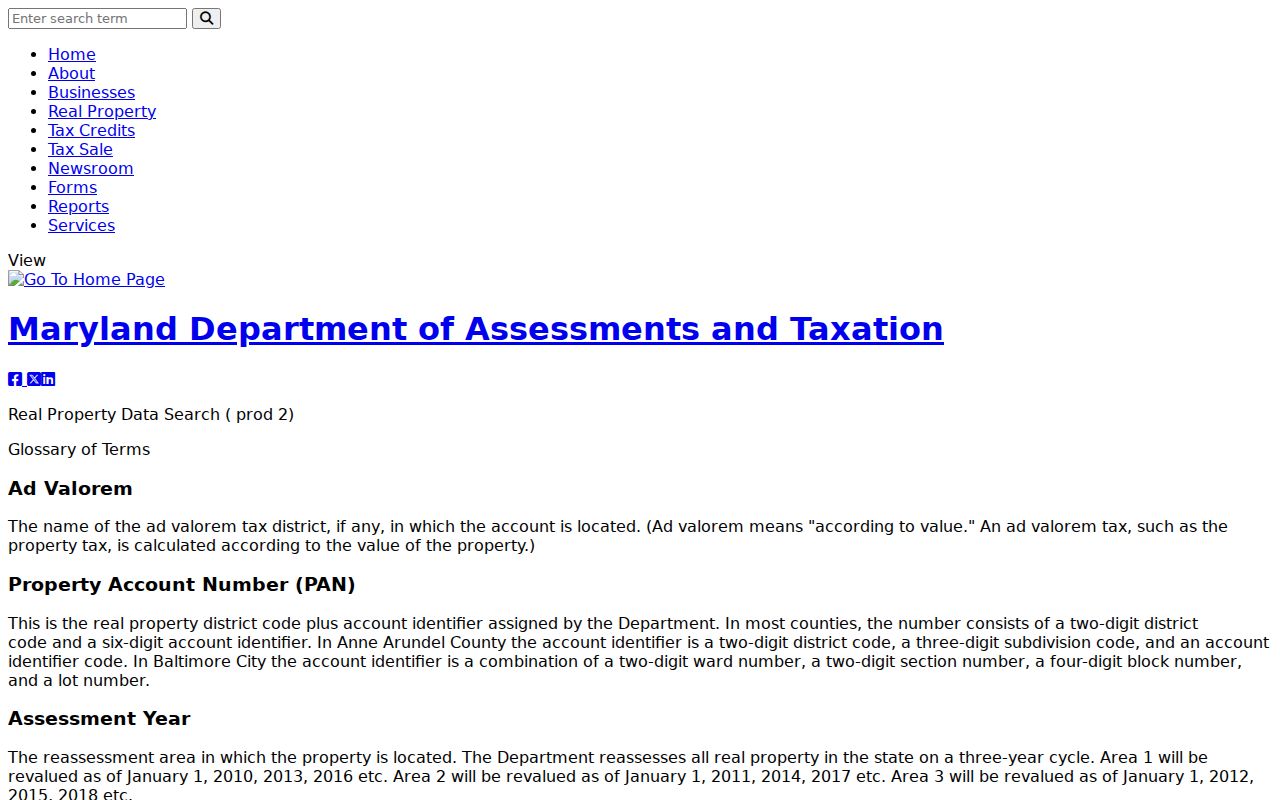
Use the glossary to decode the record's fields. Then return to the parcel page for that property's own values and dates.
Maryland Assessed Value Ratios
SDAT ratio studies test assessment levels against sale prices. The scope is a jurisdiction and a property class. That shows whether a group of assessed values tracks its market sample, not that every parcel's taxable number matches its most recent sale. The applicable ratio depends on the current report, the class, the sales sample, and the timing of assessments.
The report shows a 100 percent ratio for property not assessed on market value. Read that convention in context. Maryland's assessment fields can still differ from a transaction. Phase-in, exemptions, the sale date, or the transfer terms can all explain the gap, so keep the study separate from a parcel's own values.
Maryland Value Phase-In Cycle
Maryland reassesses real property on a three-year cycle. SDAT estimates a new market value with cost and sales-comparison methods. Any increase is phased in over three equal steps. So a notice can show a new market estimate while the assessable value climbs gradually; the lines are related, not competing answers.
A local homestead cap can limit the yearly increase in taxable assessment for a principal residence. The cap changes the tax-facing amount. It never resets the market estimate. Compare the finality date with the transfer date. Then judge whether a value is stale or inconsistent.
Maryland Land and Improvement Values
SDAT splits land value from improvement value, then adds them into a total market figure. The split can explain a result. A parcel may have vacant land, a major addition, or a change to its buildings. The record also carries the year of a qualifying major improvement. That year can point to why an assessment changed.
The cost approach estimates land plus structure replacement cost, less depreciation. The sales-comparison approach uses recent comparable sales. SDAT's figure is a mass-appraisal result. It comes from the assessment system. It does not come from a homeowner's renovation cost or a nearby asking price.
Maryland Recorded Sale Prices
Maryland deeds and SDAT records each carry a piece of the sale story. The SDAT sale segment can list the reported consideration, seller, transfer date, sales-analysis code, mortgage, and deed reference. The deed image itself may show the consideration or a transfer-tax stamp. Together those fields trace a transaction well. But two cautions apply. The sale date is not the assessment finality date. The price is also not a current market estimate.
Some recorded amounts are not true market sales at all. Nominal transfers, gifts, foreclosure deeds, corrections, and deals bundling personal property can all carry amounts that mislead a comparison. Check the instrument type and sales-analysis code first. For the recorded proof itself, follow the deed reference into Maryland Land Records.
Maryland Taxable Value and Credits
Credits and exemptions change the tax-facing value or the tax bill. They do not change the parcel's full market estimate. Homestead caps annual taxable-assessment growth on an eligible principal residence. The Homeowners' Property Tax Credit keys off household income and tax burden instead. SDAT can also flag exemption status or special-tax recapture. These may be tied to land-use treatment, rezoning, forest conservation, or similar programs.
Keep these fields separate from sale price. Keep them separate from what a local collector says is owed. SDAT handles assessments; county and Baltimore City finance offices handle bills and payments. For local bills, credit context, and assessment challenges, see the Maryland property tax records guide.
2026 Maryland Property Value Data
The Maryland Department of Planning publishes a February 2026 statewide geodatabase, 2026 parcel points and polygons, CAMA data, and sales files. Those downloads suit broad pattern studies and map work. They carry an edition date, though. A statewide file is no substitute for the current parcel page and the assessment date on an individual record. MDP's data portal describes each file and its download route; the Maryland statewide GIS and parcel data listing separates parcel geometry, assessment characteristics, and sales downloads.
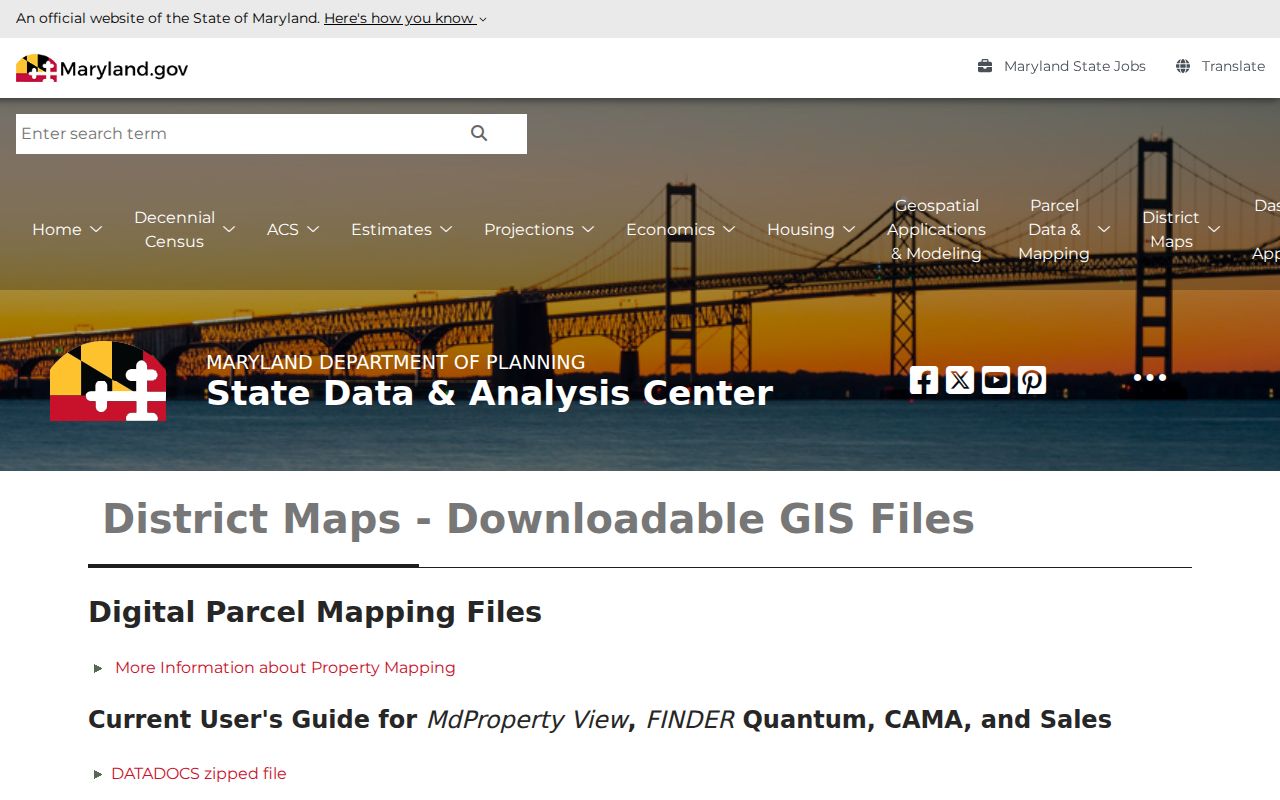
Cite the MDP edition when quoting a statewide trend. A download date and an assessor's parcel date sit at different points in the data cycle.
Maryland Sales and Value Estimates
Recent comparable sales feed the assessor's sales approach. But that comparison lives inside a mass-appraisal model. Individual parcels differ in condition, land, timing, and transaction terms. MDP's Property Sales layer and SDAT's transfer fields put sales in context. CAMA Core adds assessment-linked property characteristics on top. Use these layers to frame a question about a value. Do not use them to produce an independent appraisal. Confirm the sale record and parcel identity first. Then compare like periods and like property types. A map point or download helps pick examples. But a model output or neighborhood average never values one home for a sale or loan.
Limits of Maryland Property Values
An SDAT value is a mass-appraisal estimate for assessment purposes. It is not a sale offer or a licensed appraisal. Its date can lag a fast-moving market. A recorded consideration can mislead too. That happens when the transfer was nominal, between relatives, tied to a foreclosure, or bundled with personal property. Read the sales-analysis code and deed type before treating an amount as a comparable sale.
The assessor's number does not say what is owed to the local tax collector. Nor does it settle whether a boundary or title description is correct. For bills, credits, and assessment challenges, use the separate local and SDAT channels. The Maryland property tax records guide walks through those next steps.
Value vs price. Maryland’s assessor value is not the amount a property will sell for, and it is not a licensed appraisal. Use an appraiser for a market valuation needed for a sale or financing decision.