
Tracing Maryland Former Owners
Finding who previously owned a Maryland property means walking the deed chain backward. Go transfer by transfer. The newest recorded deed names the current owner of record. Each earlier deed carries you one step further into the past. The assessor's parcel data points you to the right liber and folio. But the deeds themselves live in the county land records. Older holdings sit in historic indexes. They may need patient browsing rather than a quick name search. Parcel descriptions, plats, and book references matter here, since street addresses shift over time. Anyone can search Maryland property records by county and start the trail.
| Record source | Coverage and access | Custodian | Use for previous owners |
|---|---|---|---|
| Modern party index | County-specific start year through current filings | Maryland Land Records | Search recorded parties and follow cited book/page references |
| Historical and retired indices | Scanned alphabetic books for periods before modern text search | MDLandRec and Maryland State Archives | Find a party entry and its land-book citation |
| County land books | Earliest surviving volume varies by jurisdiction; colonial examples survive | Circuit Court Clerk and State Archives | Read the recorded transfer itself |
| Plats and subdivision records | Recorded images with county-specific coverage | Plats.net, Clerk, Archives | Match lot, block, tract, easement, and street changes |
| Assessment and estate files | Series and online depth vary by record type and county | SDAT, Register of Wills, Archives | Supply deed references or explain an estate transfer |
A recent transfer shows up on the SDAT parcel page. Note the owner name, the Property Account Number, the legal description, and the liber/folio reference before moving on. For older transfers, go to the county's Historical or Retired Indices. Browse to the cited book and page there. Maryland's counties began recording at different dates. Any claim of one statewide earliest year would hide real gaps between jurisdictions.
Read the Maryland Deed Chain Backward
Searching for former owners is a sequence, not a one-field lookup. SDAT's Owner Name field simply carries forward the last recorded deed. Pull that deed reference and open the instrument itself. The deed begins the backward chain. Match the legal description as well as the names. That habit keeps you on the right parcel when people share a name. It also helps when the street address has changed.
- Search SDAT by address or account and note the Owner Name, PAN, legal description, and liber/folio.
- Select the right county in Maryland Land Records and search the current owner as grantee, or use the book/page jump.
- Read the deed image for the grantor, grantee, legal description, date, consideration, and any earlier deed citation.
- Search the prior grantor as a grantee to locate that person’s acquisition, then repeat for each earlier transfer.
- When the text index stops, continue through the county’s scanned Historical or Retired Indices.
- Grantor / grantee
- The person or entity conveying rights / the person or entity receiving them.
- Chain of title
- The ordered set of recorded transfers tied to the same land.
- Liber / folio
- The land-record book and page reference for an instrument.
- Legal description
- The tract, subdivision, lot, or metes-and-bounds text used to identify the land.
The Maryland Land Records 2025 release changed the search tools considerably. It merged individual and corporation searching. It also added fields for ownership, party type, text modifiers, and cross-references. The new site requires a fresh account and two-factor authentication. Its image pricing and access terms can change. When an index hands you a direct citation, the book/page jump still does the job fast.
The Maryland Courts page explains how deed records and copies work. The chain search leans on those same instruments. But it answers a different question: who conveyed the property before the current grantee.
The State Archives' guide shows how an index citation leads to a land-book page. The linked Maryland Land Records search guide documents the book and page jump fields.
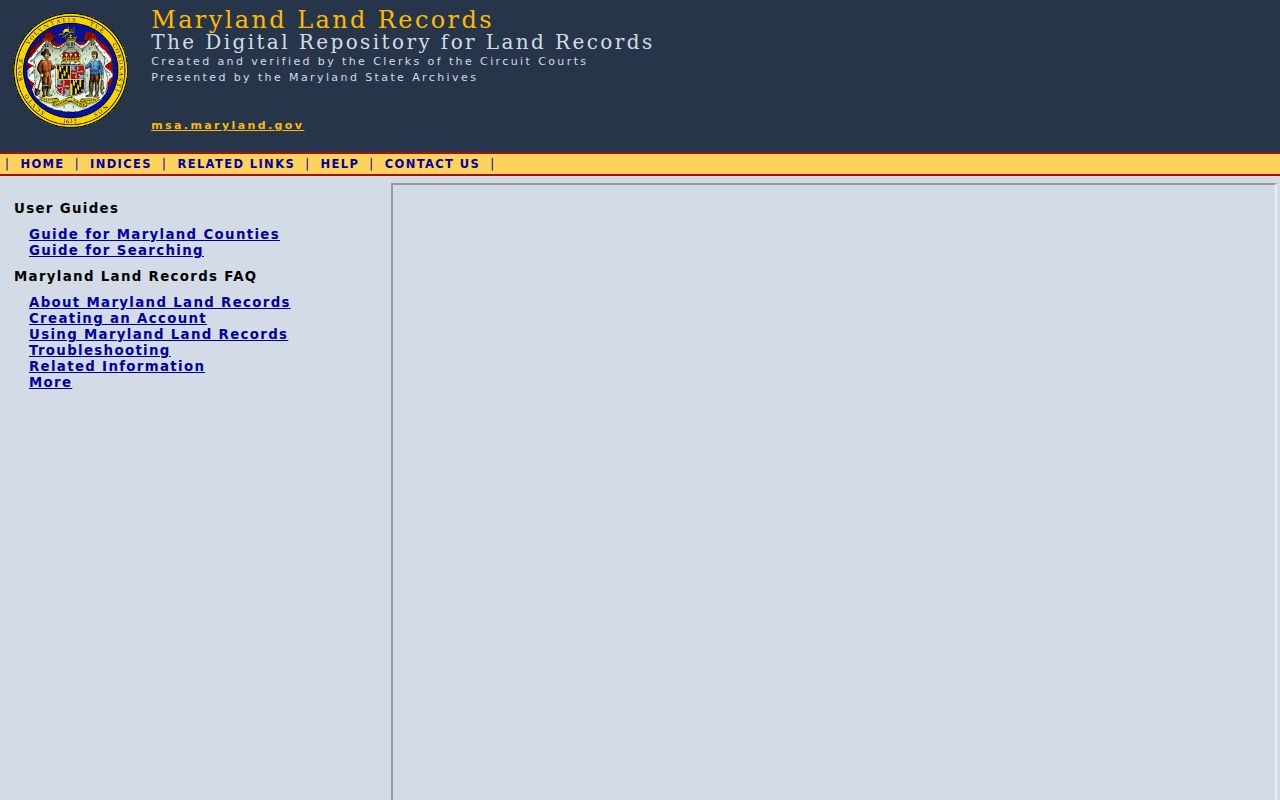
Treat any search screen as a navigation aid, not proof about a specific parcel. Match every result by legal description, county, and recording details before trusting it.
Maryland Former Owner Index Cutoffs
No single year marks the start of searchable deed names in Maryland. The Archives places the modern individual and corporation indices mostly in the 1950s through 1970s. But the exact start year appears on each county's own page. A former owner may hide under a trust, an entity, a spouse, or a legal-capacity name. A failed search can simply mean the transfer predates the text index. It can also mean the record uses a different spelling.
When a modern entry is missing, try initials, middle-name variants, and suffixes. Corporate or trustee forms are worth a try too. The 2025 fields include Contains, Fuzzy, and Soundex modifiers, though indexing quality varies by county. Record the county, party role, recording date, and book/page every time. A name match alone is never enough.
Browse Maryland Prior Owner Indices
Historical indices are scanned alphabet books, not searchable name lists. Do the owners you want predate the modern index? Pick the county and open its Historical Indices. These older interfaces label a category Active. Retired Indices hold former courthouse paper indexes transferred for preservation. Additional Indices may sit at the front or back of a land-record volume. Browse the surname section you need. Watch for spelling variants and "et al." entries. Write down the book and page before opening the volume.
The State Archives' instructions walk through this handoff. They take you from a browsed index to the cited record. Consult the Archives' guide to historical land indices whenever a modern party search ends too soon.
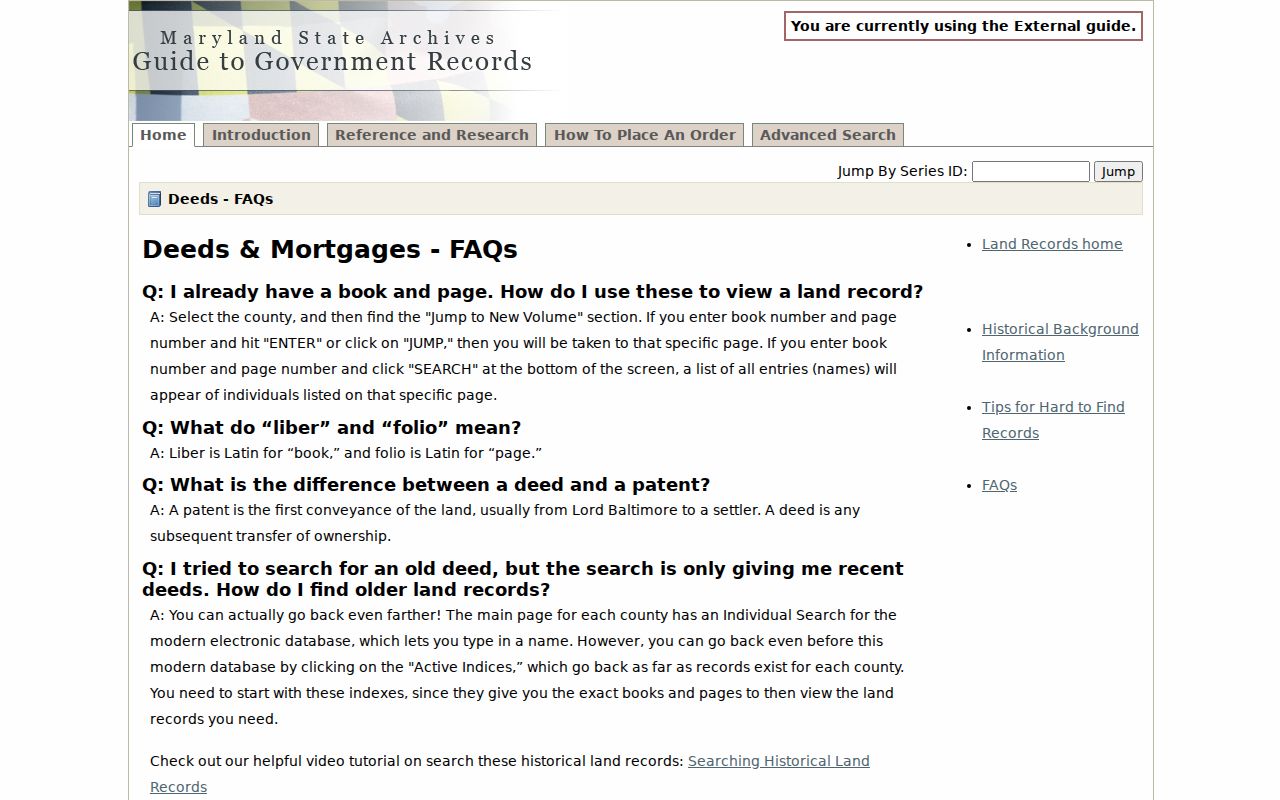
Once the citation is clear, use the volume jump or browse the book itself. The Archives explains the route, and the county index supplies the parcel-specific clue.
Maryland Estate Transfers and Deeds
An estate can break a simple line of prior owners. Search the decedent, the estate, the personal representative, and the later grantee in Estate Search. Do the same in Maryland Land Records. Estate filings may name the property, a real-estate sale, or authority to convey. The administrator's or executor's deed is the instrument that records the actual transfer. A will shows intent, but it never replaces a recorded deed in the land records.
The Judiciary's probate overview describes the Register of Wills route and related transfer records. That context helps when the chain includes a representative. But it does not mean every probate file contains a real-property conveyance.
Maryland's official probate and estate guidance points to Estate Search. It also covers the county Register of Wills.
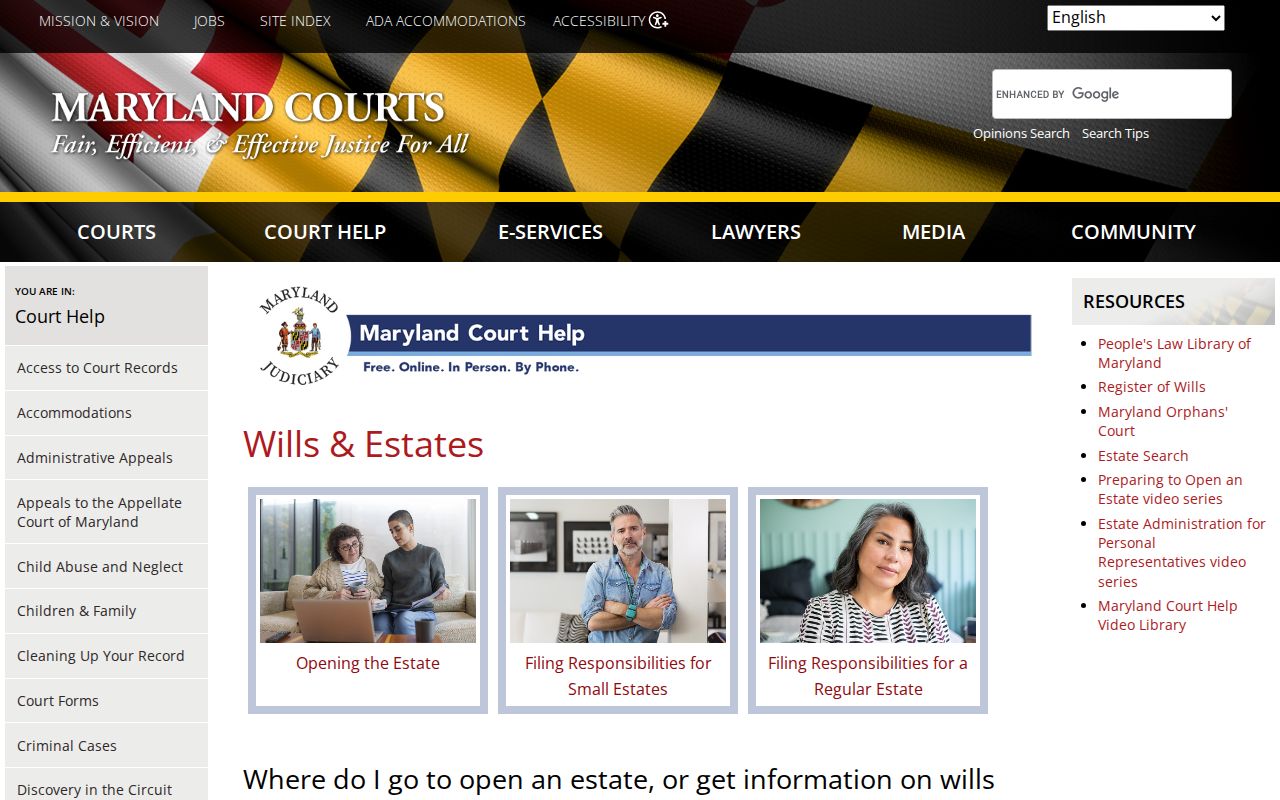
Compare the estate file against the deed's grantee, legal description, and case reference. A changed assessment name alone never proves a transfer.
Maryland Property Plats and Address History
Street names and house numbers change over time. A deed's legal description is steadier ground. Its lot, block, subdivision, tract, or metes-and-bounds wording can anchor a parcel across generations of addresses. Plats.net supplies digital image references for recorded land-survey, subdivision, and condominium plats. One plat may show lot and block lines, rights-of-way, easements, dedications, and resubdivision notes. Match its book/page or plat number against the deed and the current GIS parcel whenever the older deed names a farm or tract instead of a modern street.
A plat paired with a tax map can link a place across eras, though neither counts as a current boundary survey. The same ground in Maryland might carry a colonial tract description, a later street name, and a modern PAN all at once. Keep every identifier in your property records notes. Older terms are clues, not obsolete noise.
Calvert’s Maryland Owner Trail
Calvert County shows why a gap in an old chain deserves a second look. The State Archives describes the CE13 land-index series covering 1812–1958. Its 1812–1894 volume carries index entries for land records destroyed in the 1882 courthouse fire. Those entries were later re-recorded from originals. So a missing first-generation volume does not mean no transfer occurred.
For an affected period, hunt down the reconstructed or re-recorded citation. Then read the instrument it points to. That detail belongs to Calvert's record history alone. It is not a rule for every Maryland county or every deed gap you meet in property records.
Maryland Property History in Directories
Directories and newspapers can fill the space between deed dates. They show who actually used an address. The State Archives, Baltimore City Archives, Enoch Pratt, and other repositories hold runs that differ by city and year. Baltimore directory material reaches back to 1752 across several collections. Annapolis holdings include late nineteenth- and twentieth-century city and telephone directories. Coverage is uneven. A missing year proves nothing about whether a property or person was absent.
Street sections might list a number, name, occupation, ward, and sometimes an owner-or-renter mark. Such an entry can tie an old street name to a current parcel in a property search. But the occupant may have been a tenant, boarder, caretaker, or business. It may not have been the owner of record. Treat directories as context. Then return to deed records and estate files for the transfer history.
Where Older Maryland Deeds Are Held
Maryland State Archives finding aids point to county deed books, land patents, rent rolls, assessments, and newspapers. Still more sources appear in them. Transferred land books may sit at the Archives. A Circuit Court Clerk holds current local land records and courthouse public terminals. Libraries and historical societies sometimes keep microfilm or local indexes. These can bridge a missing online series. The right route depends on the county and the citation you hold.
Fees are set by schedule. The Archives lists $10 for a specific-citation copy of up to 20 pages. A research search of up to 20 pages costs $25. Extra pages cost $1 each, and certification runs $10 where offered. Maryland Circuit Court Clerk copies generally run $0.50 per page under a separate fee schedule. Confirm current terms through the Archives order service and the local clerk first. An index citation or search request is not an issued certified copy.
How Far Back Maryland Owner Records Reach
Maryland's recorded land history reaches into the colonial period. How far back you can trace depends on the county and the record series. State Archives holdings date from the province's founding in 1634. They include patents and warrants, rent rolls, county land indexes, and assessments. County deed books do not all start in the same year. For one parcel's depth, check the county collection guide. Follow its oldest surviving index or volume.
Maryland Land Records began in 1999 and now holds modern and historic instruments. Its text search is not the whole archive. A gap might reflect a county cutoff or a spelling variation. It could also stem from a re-recording or a shift in the parcel description. Former-owner research serves house history, title work, and property due diligence well. Never use names or address clues to follow, threaten, or harass living people.
Lawful use. Use former-owner records for property history and responsible due diligence. Do not use names or address clues to follow, threaten, or harass anyone.