
What Maryland Deed Records Show
Circuit Court clerks across Maryland record deeds. They also record any other instrument that affects an interest in real property. The land-record image is the filed document itself. The index helps you locate it by party, instrument type, date, or book and page. To see the actual terms and the legal description, you have to read the instrument. A deed transfers rights. A mortgage or deed of trust secures a debt. A release records a later change to that security. Keep this in mind. No index label or single document proves a property has clear title.
| Deed Type | What It Does | Common Use |
|---|---|---|
| General or special warranty deed | Conveys the rights described in the instrument; warranty terms depend on its wording. | Review the filed deed and cited prior instrument. |
| Quitclaim deed | Records the interest described by the parties without the index itself defining its scope. | Check names, capacity, consideration, and legal description. |
| Personal representative or administrator deed | Records a transfer by an estate representative. | Pair it with the Register of Wills file and estate authority. |
| Trustee deed | Records a transfer by a trustee or in a court-related sale process. | Check the related court case and later deed. |
| Deed of trust or mortgage | Records a security interest, not a new owner by itself. | Look for a later release, satisfaction, or assignment. |
| Easement, right-of-way, or lease | Records a use, access, or possession interest that may affect land. | Compare the instrument with a later release or plat. |
Other indexed instruments include assignments, liens, powers of attorney, plats, condominium declarations, agreements, and affidavits. The exact instrument-type choices vary by county and index generation. Maryland Land Records does not publish one universal list until a county is selected. A judgment, tax lien, or foreclosure may also live in a separate court or local-tax record. That record sits outside the deed image entirely.
Maryland Deed Records Stay with Circuit Court Clerks
The Circuit Court Clerk's Department of Land Records is the county custodian for recorded instruments. Those include deeds, mortgages, releases, easements, liens, plats, and other documents. Maryland Land Records serves as the statewide online repository. Recording itself stays local. Coverage for text-searchable names begins at different dates in each county. Archives guidance places many modern electronic indices somewhere in the 1950s through the 1970s, so check the selected county's own cutoff. A modern search may return no name hit. Older books may still survive in the clerk's holdings.
Maryland Courts describes both online access and courthouse public terminals. A clerk in person can help locate a citation. The clerk does not perform a title search or give legal advice. The Maryland Courts clerk directory routes a request to the right county office.
Use the directory to reach the custodian for the jurisdiction where the parcel is recorded. No one clerk holds every Maryland deed.
The New Maryland Land Records Login and Access Terms
Maryland Land Records version 5 launched on November 17, 2025 at landrec.msa.maryland.gov. Old accounts were retired. A new account is required. The site now uses two-factor authentication. The release merged the corporation and last-name field. It also added tools for ownership, party type, instrument, remarks, cross-reference, date, and sorting. It separates free, paid, pending, and expired pages. Purchased pages stay in the account for 30 days. A page downloaded to a local device can be kept. The Archives says its pricing model may change as usage is reviewed. So do not assume every image is free or permanent.
Create the account and read the current access notice before starting a chain search. The official Maryland Land Records login page shows the account and code step.
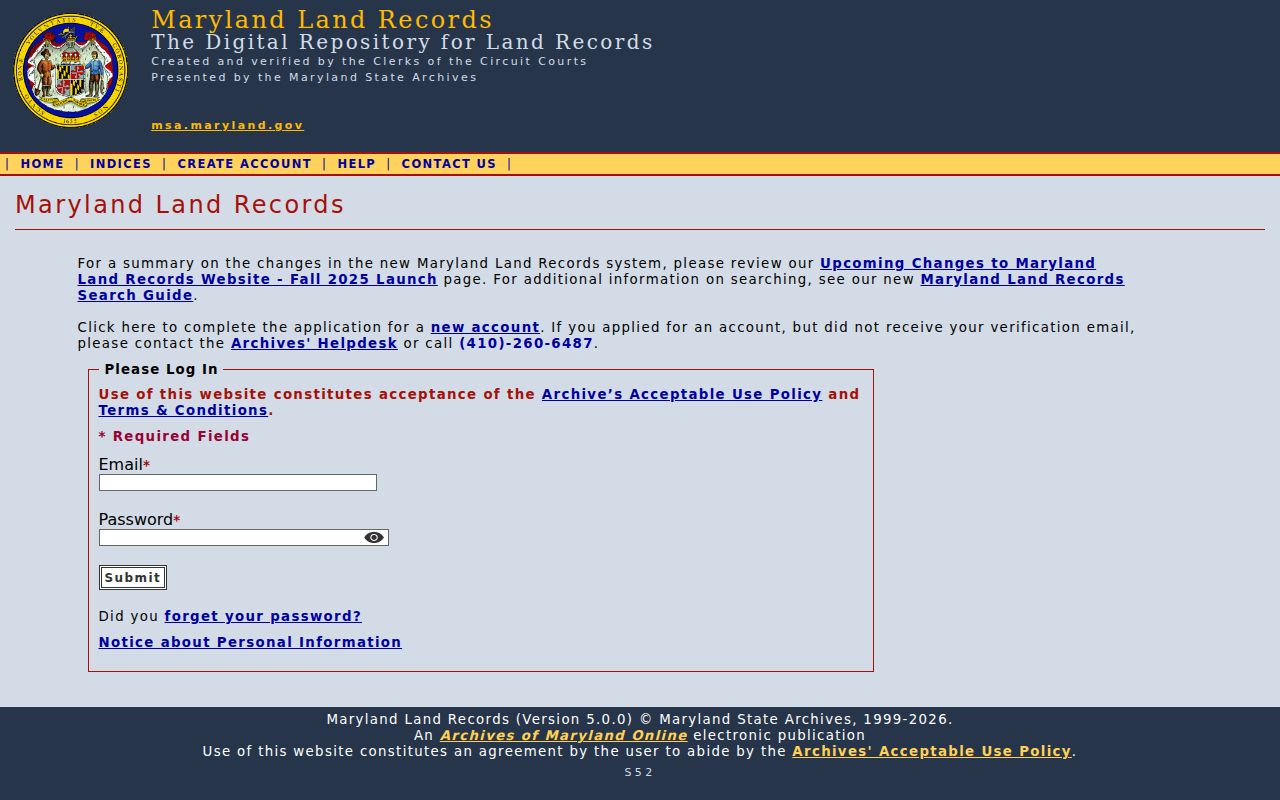
The account screen is part of the current workflow. Access to an image can still depend on the county, the document, and the pricing notice in effect.
Search Maryland Deed Records by Party and Instrument
The index works best when you know the property's county and at least one party name or SDAT liber/folio reference. Pick the party role that fits your question. A grantee receives the transfer; a grantor conveys it. Search an owner as grantee to find the acquisition, inspect that deed, then treat the prior grantor as the next name and trace backward. Names shift with middle names, suffixes, trusts, LLCs, legal capacity, and county indexing practice. Test sensible variants instead of accepting the first result.
| Portal field | Recorded-search use |
|---|---|
| County and clerk | Select the jurisdiction; clerk initials matter for a book-and-page jump. |
| Party name and modifier | Use the merged corporation/last-name field and choose an exact, begins-with, contains, fuzzy, or Soundex match. |
| First, middle, suffix, or legal capacity | Try optional name details when indexing varies or a party acts as trustee or representative. |
| Ownership and Party Type | Choose corporation or individual, then all parties, grantor, or grantee. |
| Instrument, remarks, and date range | Refine the result list; exact instrument options differ by county and index. |
| Book, page, and cross-reference | Open a known land-record citation or related volume reference. |
The free Maryland Land Records search guide explains the book/page route and each county's name search.
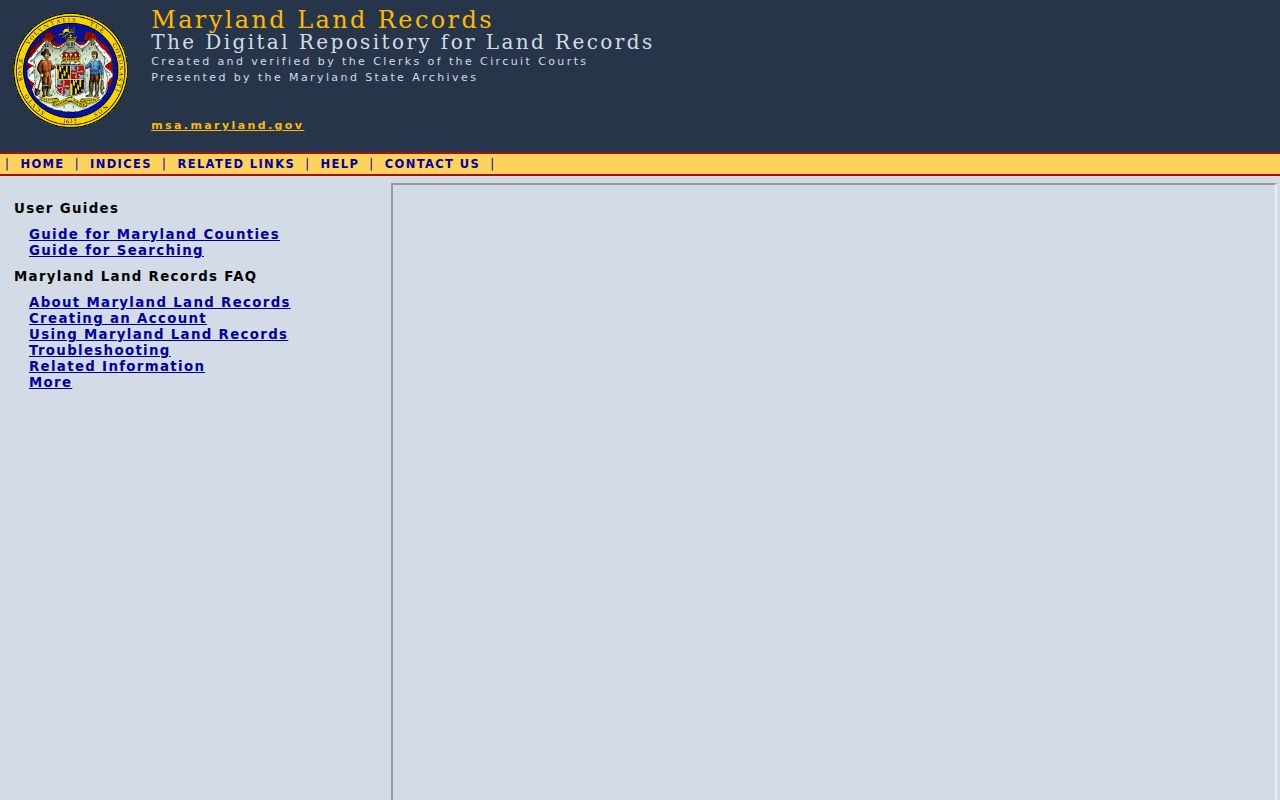
Use its field notes to turn an index result into a specific document. Then work backward through earlier owners.
- Select the county and search the current owner as grantee, or use the SDAT deed citation when the name is noisy.
- Open the deed image and record its grantor, grantee, recording date, consideration, and land description.
- Search the grantor as grantee to find the prior transfer, matching the legal description at each step.
- If the name index stops at its county cutoff, move to the scanned historical or retired index for an older citation.
- Grantor
- The party named as transferring an interest in the instrument.
- Grantee
- The party named as receiving the interest.
- Chain of title
- The linked sequence of recorded conveyances for the same land.
- Liber/Folio or Book/Page
- The clerk’s volume and page reference; the portal’s jump tool uses the citation rather than a name search.
Use Liber and Folio to Open a Maryland Deed
SDAT often supplies the land-record reference next to the assessed parcel. Maryland Land Records' Jump to New Volume option takes the clerk, book, and page, and the search guide notes that a page jump returns the cited page. Keep both the PAN and the liber/folio. The account identifies the assessment record. The book and page identify a recorded instrument. A second deed reference may also appear on SDAT. The deed image can contain party names, the legal description, consideration, recordation date, notarization, tax endorsements, and references to prior deeds. Confirm its description matches the parcel rather than trusting an address alone.
A land-record citation earns its keep when a party-name search turns up several people with the same name. Compare county, date, party role, and property description before saving the result. A mortgage or assignment in the same search is a different instrument from the deed that transferred the ownership interest.
Older Maryland Deed Records Need Historical Indices
Maryland's modern online name index is only part of the story. Land-record history goes back much further. For older deed records, open the county's Historical Indices, Retired Indices, or Additional Indices. Browse the scanned alphabetical books there. Most scans are not keyword searchable. Instead, find the surname and party role in the index. Copy the land-book citation and jump to that book and page. The State Archives preserves county books that were transferred over time. Its holdings reach back to the earliest surviving record for each jurisdiction. Cutoffs and gaps vary by county. One earliest year never fits the whole state.
One Calvert County index series covering 1812–1894 is an example. It includes entries for land records lost in the 1882 courthouse fire and later re-recorded from originals, according to the Archives. So a missing original can reflect loss and reconstruction, not proof that no transfer occurred. For a practical backward search, use these index steps. See the former property owners guide. The State Archives deed-index guide gives county-specific steps and the book/page method.
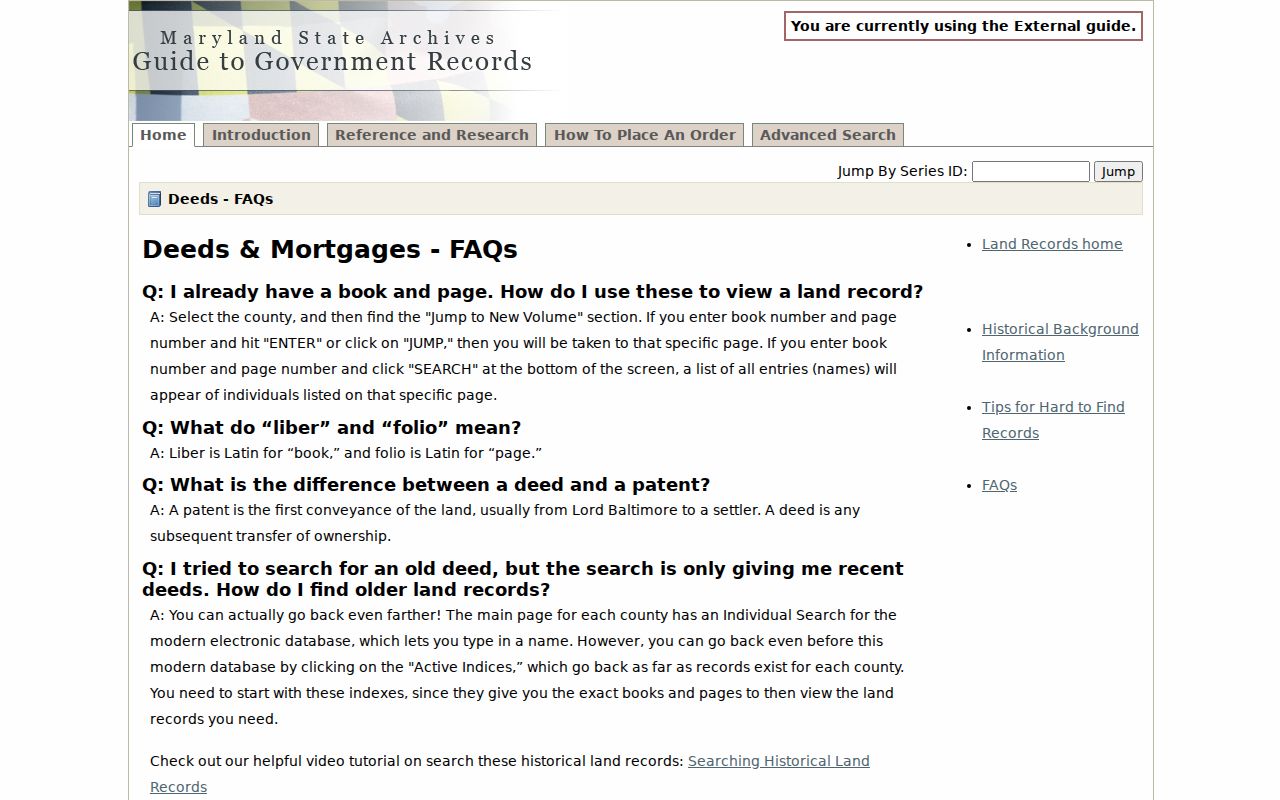
That route extends a name search into scanned books without implying the same cutoff or completeness in every county.
Maryland Liens and Foreclosures Use Separate Search Paths
Land Records holds more than deeds. A mortgage, deed of trust, assignment, release, and easement can all appear there. So can a mechanic's lien, HOA or condominium lien, and recorded judgment or tax lien. A release or assignment changes the status or holder of an instrument. It is not a new deed. A release alone is not a complete title conclusion. Judgment information has its own Judiciary search. It offers fields for person or company, county, and filing date.
When the question concerns a judgment, search the official Maryland Judiciary Judgment and Liens portal. A foreclosure or quiet-title case belongs in Maryland Case Search and the Circuit Court file. The resulting deed or sale record must then be pulled from Land Records. Delinquent taxes and tax-sale status sit with the local county or Baltimore City collector. The docket, lien index, land record, and tax account are linked clues. They are not substitutes for one another.
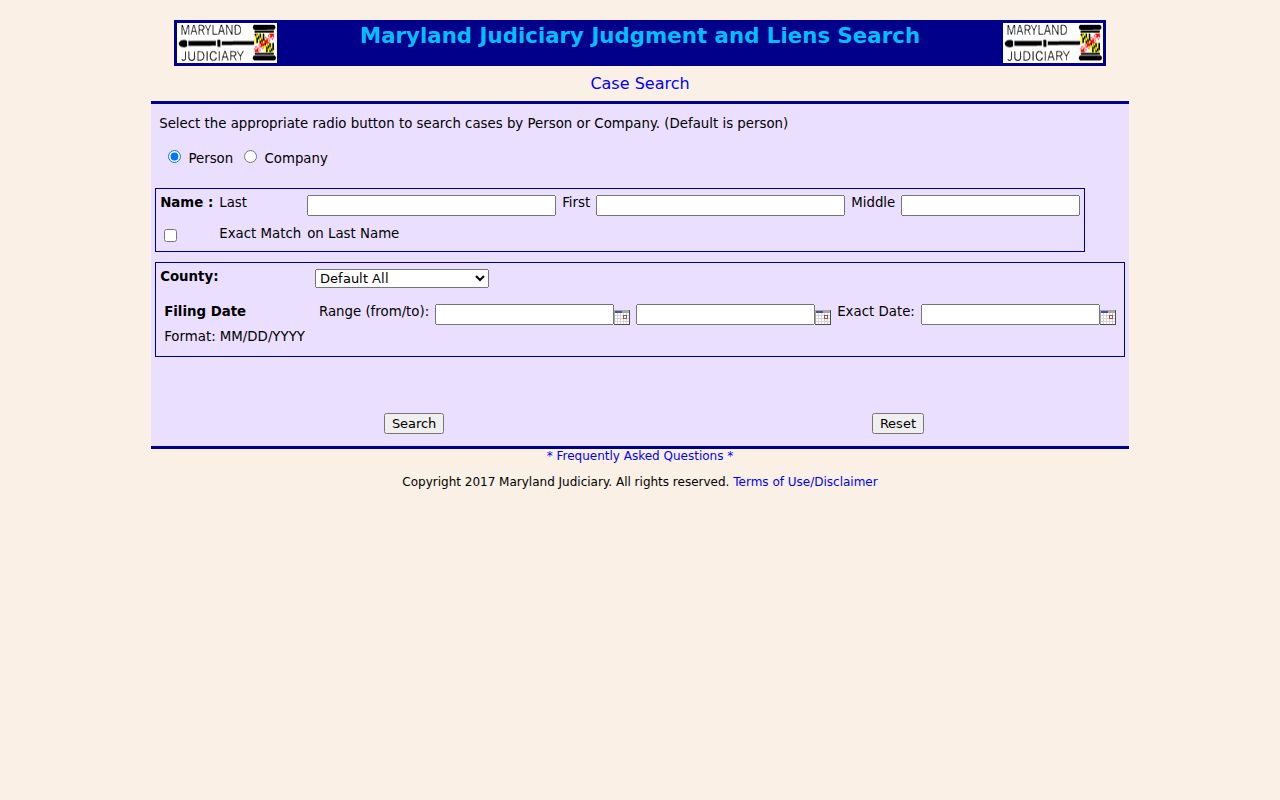
That split shows why a deed-only review can miss a court-record trail tied to a parcel.
Getting a Copy of Maryland Deed Records
For a current indexed deed, use the Maryland Land Records image link. Do this after confirming the county, party, and citation. Online account and image pricing can change. A second route is the Circuit Court Clerk's public terminal or copy counter. Maryland Courts lists a general clerk copy price of $0.50 per page. Certified-copy charges are set by the court fee schedule. Call the right clerk from the statewide directory before traveling or mailing a request. County hours and certification rules vary.
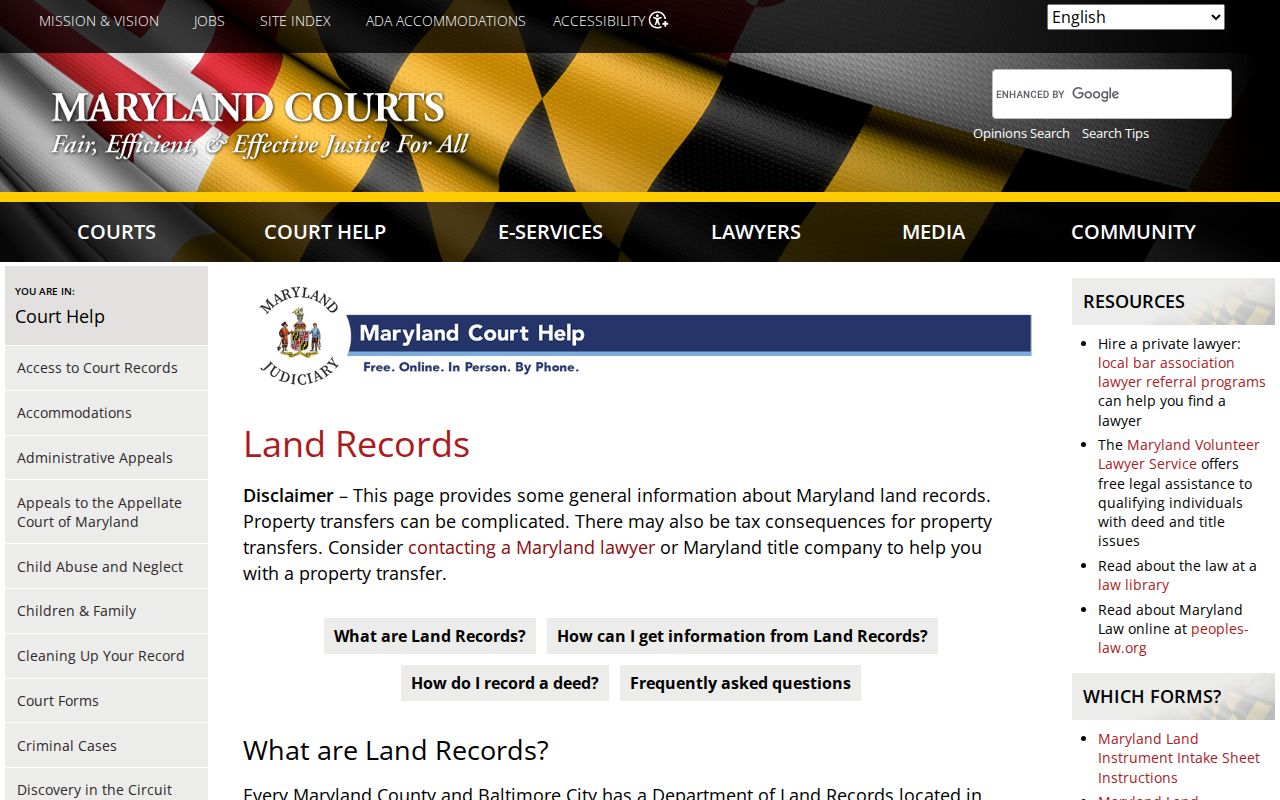
The Maryland Courts land-record access page explains public access and courthouse copies, and it gives its general per-page charge. The page also notes that clerks do not perform title searches, draft deeds, or give legal advice.
Match the route to the need. Go online for a quick image, the clerk for an official copy, or the Archives for an older citation or transferred volume.
The Maryland State Archives takes online, mail, and phone orders for listed historical records. Its order page lists a specific-citation copy search at $10 for up to 20 pages. It also lists a staff research search at $25 for up to 20 pages. Extra pages run $1 each. A $10 certification add-on applies where offered. These are Archives order terms, not the online Land Records image price. Confirm the current form and fee before payment. Capture the details first. Note the county, record type, grantor and grantee, date, and book/page so the request stays specific.
Recorded, not guaranteed. Maryland deed records show instruments filed with a clerk; an index hit does not establish clear title or reveal every unrecorded interest. A complete title review requires a title professional.
Check a Maryland Deed-Copy Offer Before Paying
Maryland clerks warn about mailers that repeat an owner of record's name, lot description, transfer date, and value. These mailers then offer a property profile or deed copy for a high fee. One county clerk cites a $99 profile offer as an example. Phishing messages may also claim a sale occurred. They may ask a reader to click a link or share account details. Maryland publishes no single statewide property-fraud-alert signup. Treat a clerk's county page as local guidance, not a statewide alert service.
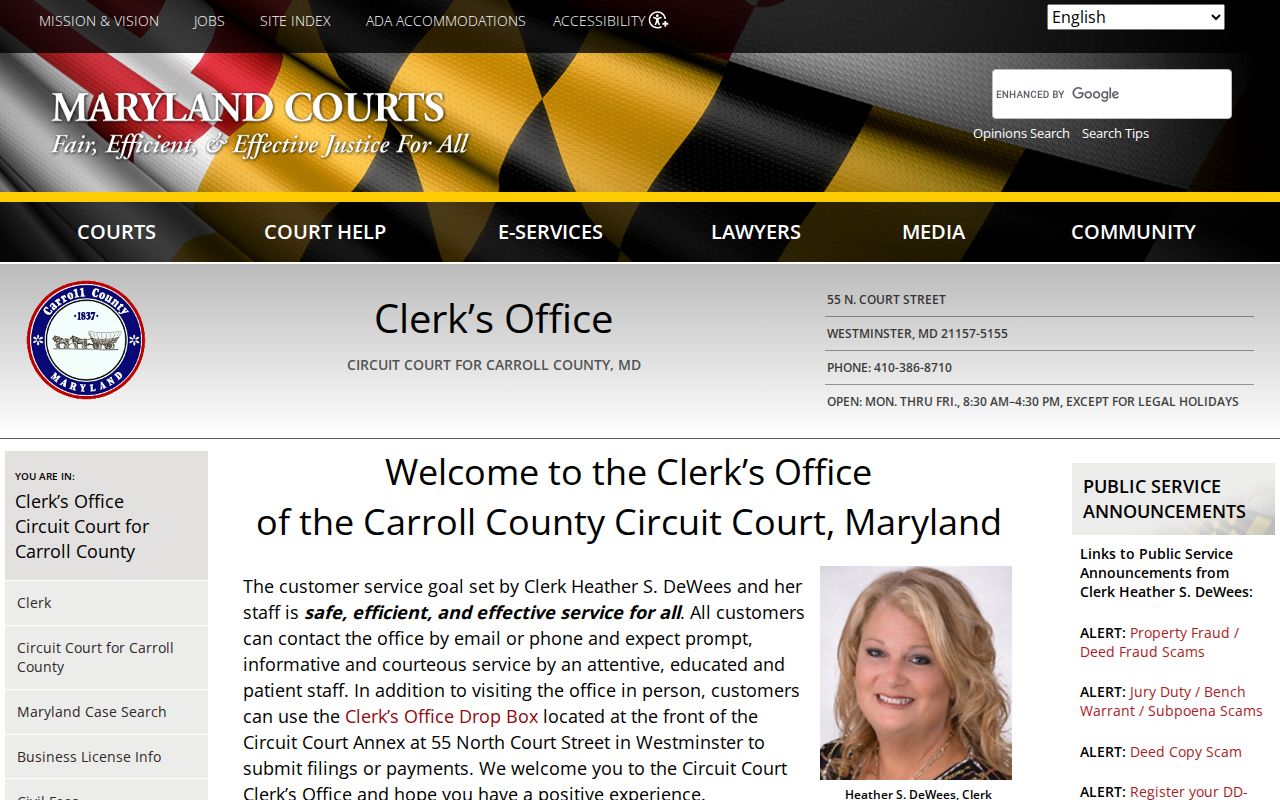
Use the official Circuit Court directory to reach the custodian. Compare the PAN and deed citation in SDAT. Open the official Land Records site directly. Skip any QR code or payment link in a mailer. Order the recorded copy from the clerk or the Archives. Inspect the actual land instrument as the evidence. The Carroll County Clerk's warning page documents a county example of paid mailers and phishing notices.
Official guidance helps separate a real public-copy request from a private sales letter built on recorded property details.